
Set your stake
Bets run from €0.05 to €50. Medium volatility (3/5) keeps sessions swinging without pure all-or-nothing pacing.
Le Prechaun pays in clusters of 5+ matching symbols on a 6×5 grid with Super Cascades. After wins clear, Golden Squares and multipliers keep the round alive.
Bets run from €0.05 to €50. Medium volatility (3/5) keeps sessions swinging without pure all-or-nothing pacing.
Connect 5 or more matching symbols. Winning symbols cascade out, including related pay symbols in Super Cascade mode.
Wins mark cells as Golden Squares. Land a Rainbow to reveal Coins (cash), Clovers (boosts), Bags (adjacent collectors), or Pots (full-grid collectors).
Wilds in wins stamp ×2 on their cell. Repeat wilds on that cell double the multiplier while it also acts like a Golden Square.
3, 4, or 5 FS symbols open Arc Adventure, Clover the Top, or the Hidden Epic Shamrock ’N’ Roll.
Use the free demo to watch Coin / Clover / Bag / Pot chains before you touch higher feature buys.
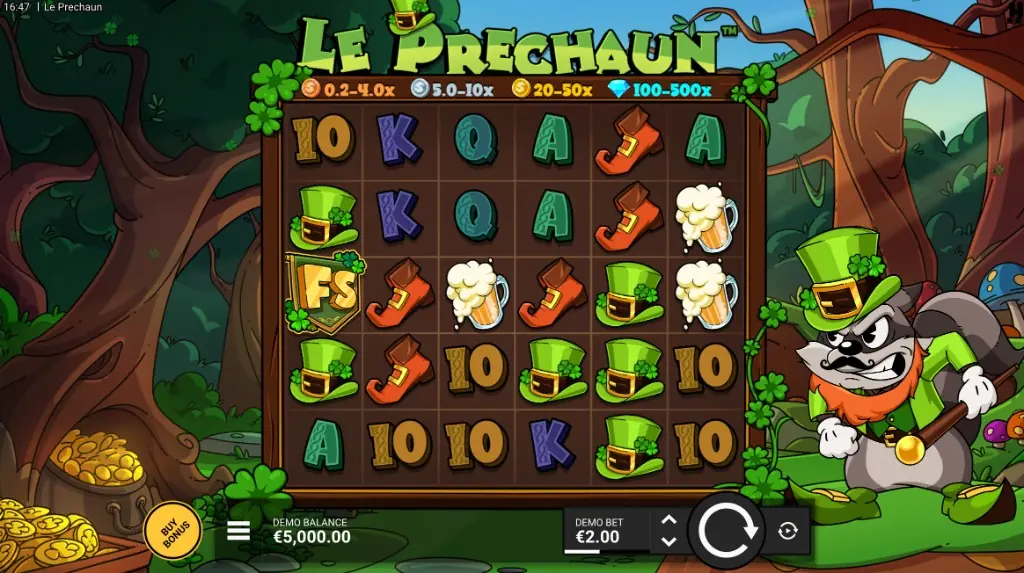
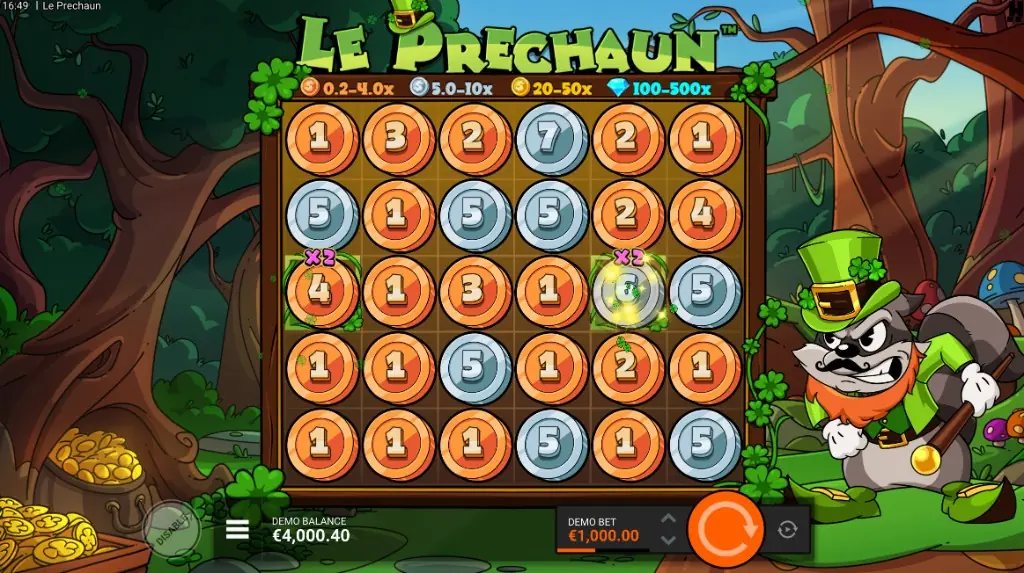
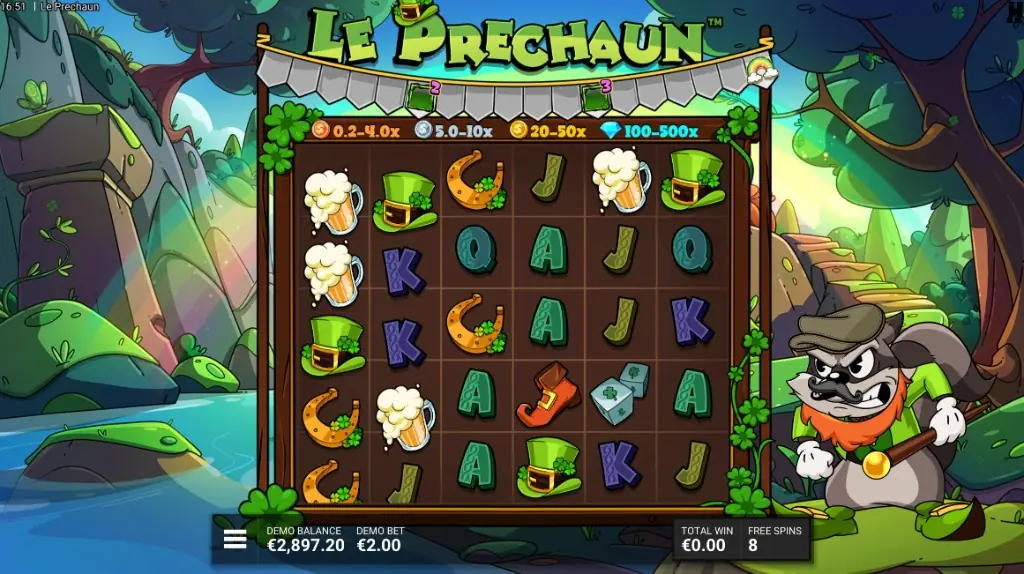
Le Prechaun is a 6×5 Cluster Pays slot by Hacksaw Gaming, released on July 16, 2026. Smokey Frenchie, the cigar-carrying leprechaun, presides over a grid built around connected symbol groups, cascades, Golden Squares, Position Multipliers, rainbows, and three free-spin features. This guide explains what to watch from the moment you set a stake to the point where a bonus ends.
Start in demo mode. The rules are easier to understand when you can pause between rounds and inspect the board without worrying about money. A free balance has no cash value and does not reproduce the emotional pressure of paid play, but the symbol behavior and control flow make it a useful classroom. Learn why a cluster paid before increasing the speed or trying a feature buy.
The official reference is hacksawgaming.com/games/le-prechaun. The game offers stakes from €0.05 to €50, a maximum win of 15,000x stake, medium volatility rated 3 out of 5, and an approximate hit frequency of 37.8%. Its RTP can be configured at 97.52%, 96.28%, 94.29%, 92.28%, or 86.31%. Check the information panel in the exact version you open because the highest setting is not automatic.
Use the bet control to choose an amount between the available minimum and maximum. The published range is €0.05 to €50 per paid spin, though another currency or local limit may appear. The selected stake is the base for all win multiples. A 10x result pays ten times that stake, while the 15,000x cap represents fifteen thousand times it.
For demo practice, start at the minimum and leave the stake unchanged for at least fifty spins. A steady setting makes it easier to compare cluster values, observe the hit rhythm, and understand what a multiplier contributed. If you change the stake every few rounds, the cash figures become noisy and a larger win can look feature-driven when it mainly reflects a larger bet.
For paid play where allowed, decide the total session budget first and divide it by the stake. A €10 budget at €0.10 allows one hundred spins if no wins are recycled; the same budget at €1 allows ten. Actual session length changes as returns arrive, but the calculation shows the initial exposure. Never raise the bet to recover a loss. The random outcome has no memory of what the previous spin cost.
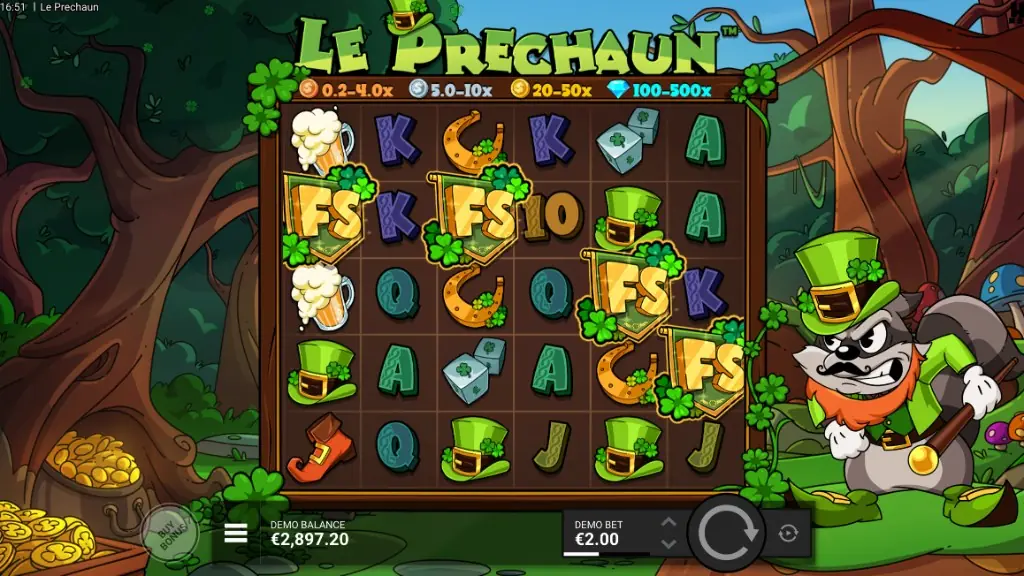
Le Prechaun does not use fixed left-to-right paylines. A win forms when enough matching symbols connect through horizontal or vertical contact. Picture the matching symbols as squares on graph paper. If two share a full edge, they belong to the same group. If they touch only at a corner, that diagonal contact does not join them. The paytable states how large each cluster must be and what each size pays.
A cluster can bend around the grid and does not need to start on the first reel. That freedom is why the 6×5 format matters: thirty positions allow irregular groups to form in many places. Scan the whole board after it settles. The game will mark a valid group, but learning to see it yourself helps explain why one set paid while two nearby islands of the same symbol did not.
Cluster size is only one part of the value. Symbol rank matters, as do any wilds and multipliers involved in the calculation. Ten low-paying symbols can return less than a smaller qualifying group of a premium symbol. Read the paytable in stake multiples rather than guessing from the artwork. A gold-looking icon is not automatically the most valuable one.
After a winning cluster is counted, its symbols disappear. Symbols above drop into the empty positions and new ones enter the grid. If the new arrangement creates another valid cluster, that cluster pays and the process repeats. These consecutive removals are cascades. They all belong to the same paid spin, so you are not charged again while the current sequence continues.
A super cascade extends this board-clearing idea and can create a more dramatic refresh. Watch the grid state, Golden Squares, and position values as it happens. The useful question is not how long the animation lasts, but what changed before the next evaluation. A chain with four tiny clusters may pay less than one short event that connects a strong symbol through multiplied positions.
Do not press spin repeatedly during a cascade. Let the game finish counting and show the final amount. Faster settings can be convenient once the rules are familiar, yet normal speed is better for the first practice session. Try narrating the sequence: “cluster clears, symbols fall, new cluster connects, multiplier applies.” If you cannot explain a result, open the paytable and replay any available history before continuing.
Golden Squares mark positions where extra value can emerge as the cascade sequence develops. Their reveals include coins, clovers, bags, and pots. The item matters because each type contributes differently to the current event or feature progress. Slow the game down when several gold positions are active. The visual sequence shows which square opened and what was collected from it.
Coins represent direct prize values. Read them in relation to the current stake and do not assume that a large printed number means the same cash amount at every bet. Clovers contribute to the Lucky Charm Bar, creating visible progress toward feature activity. Bags and pots are larger-looking discoveries tied to the collection system. Their exact treatment should be read from the in-game rules for the selected version.
A Golden Square does not let the player choose a hidden item. There is no reliable stop timing, spin-button rhythm, or screen location that improves the reveal. The outcome is generated by the game. Changing stake because a square “looks ready” does not increase the chance that the next random result uses it in the hoped-for way.
Position Multipliers add value to particular grid locations rather than permanently changing a symbol. When a winning group uses an active location, the displayed multiplier can affect the cluster calculation. Cascades make this interesting because new symbols may fall into a position that was already developed earlier in the sequence. A plain symbol can become valuable because of where it lands.
Wilds help connect matching symbols and can carry multiplier power. When more than one relevant multiplier participates, their effects can stack according to the game rules. This is the route behind many of the strongest-looking wins: a useful cluster reaches wild positions, values combine, and the total grows far beyond the raw symbol payout. Watch the calculation panel instead of trying to multiply every moving number mentally.
Position values create suspense, but they do not make nearby symbols more likely to land. A strong multiplier can remain unused. That is normal variance, not a malfunction. In demo mode, take screenshots or notes when a stacked result occurs, recording the starting cluster value and final paid multiple. After a few examples, the mechanic becomes much easier to recognize.
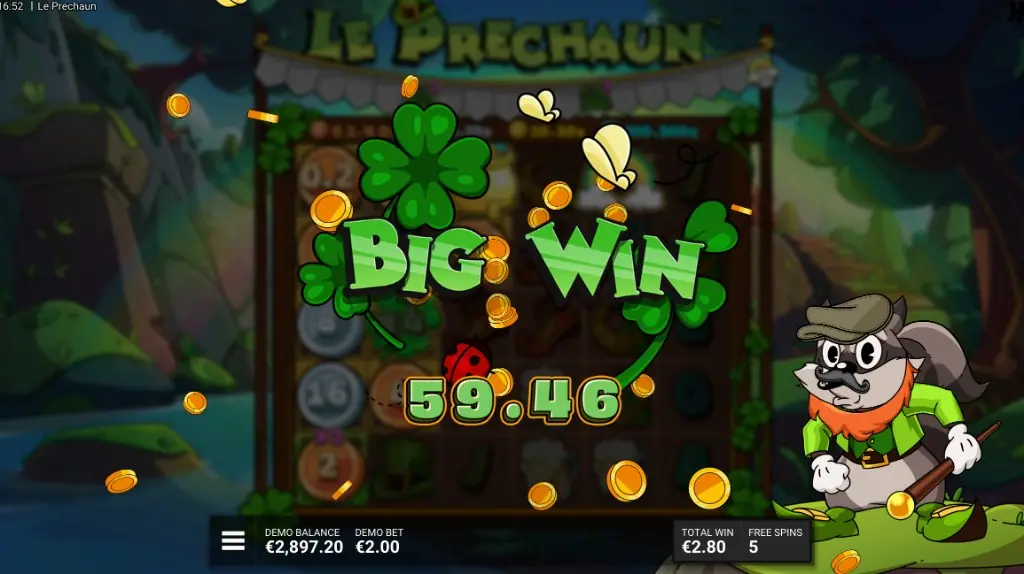
Three free-spin symbols trigger Arc Adventure. Four trigger Clover the Top. Five trigger Shamrock 'N' Roll, the top mode with a Hidden Epic element. This 3FS, 4FS, and 5FS ladder makes the entry level easy to read: count the triggering symbols, then note the feature name shown by the game.
Arc Adventure is the first free-spin route and provides the basic introduction to bonus play. Clover the Top requires the stronger four-symbol trigger. Shamrock 'N' Roll sits above both, and its Hidden Epic component adds an extra layer to the five-symbol event. Consult the feature panel for the precise modifiers applied in your version, since this guide does not invent an unconfirmed number of spins, starting multipliers, or guaranteed rewards.
A trigger starts a feature; it does not promise that the feature returns more than the stake or the cost of reaching it. Free spins can finish with a small total when the useful symbols and positions fail to connect. Strong rounds need the mechanics to cooperate, especially Golden Square activity and multiplier stacking. Let the full feature resolve before judging its payout.
Le Prechaun includes feature buys where the market allows them. A buy lets the player pay a displayed price to enter a feature directly instead of waiting for a natural 3FS, 4FS, or 5FS trigger. Some regions prohibit this option, so the menu may be absent. Availability also does not mean a purchase is discounted or likely to return its cost.
Before selecting a buy, read its price as a multiple of the current stake. If a feature costs the equivalent of many base spins, one click concentrates that exposure into one random bonus. Check which named mode is being purchased and whether the menu states any changed RTP or conditions. Cancel if the price or rule is unclear.
Practice each available option with demo credit before considering paid use. Record ten or twenty results if you want to understand the range, but do not treat the average of that small sample as the feature's true return. A spectacular first buy is an anecdote. A run of weak buys is also an anecdote. Neither changes the next randomly generated outcome.
Begin with fifty base spins at the minimum stake and normal animation speed. For each hit, identify the cluster before it clears. Note whether the win ended immediately or cascaded, and watch for any Golden Square reveal. Ignore the final demo balance during this first pass.
Next, spend fifty spins watching only developed positions. Track where a Position Multiplier appears, whether a wild reaches it, and how the displayed calculation changes when values stack. Then devote another block to coins, clovers, bags, pots, and the Lucky Charm Bar. Separating the systems makes each one easier to learn than trying to decode the whole screen at once.
Finally, observe the free-spin triggers and any Rainbow or Epic Rainbow event. Use feature buys in demo mode if natural triggers take too long for rule practice. Compare Arc Adventure, Clover the Top, and Shamrock 'N' Roll by their mechanics, not by which one happened to pay best in a tiny sample.