Le Prechaun is Hacksaw’s Irish-themed Le series chapter: familiar Golden Squares collection with a new Position Multiplier layer and a 15,000x ceiling.
Le Prechaun slot review: is Smokey Frenchie worth a spin?
Le Prechaun is a 6×5 Cluster Pays slot from Hacksaw Gaming, released on July 16, 2026. Its star is Smokey Frenchie, a small leprechaun with a large cigar and the guarded expression of someone who knows exactly where the gold is buried. The game belongs to the same mischievous crime-comedy world that players may associate with the Le Bandit-style collection, but that family resemblance should not be mistaken for identical mathematics. This review treats Le Prechaun as its own game, with its own feature sequence, RTP settings, and pace.
The quick verdict is positive, with limits. Le Prechaun has more going on than its cheerful symbols first suggest. Golden Squares can reveal prizes or feed the feature system, Position Multipliers reward repeated activity in the same reel locations, and the three free-spin modes give the bonus hunt a clear shape. The 15,000x maximum win is large enough to matter without changing the basic truth of play: most paid spins will produce modest results, dead results, or short clusters rather than a headline payout.
It is best approached in demo mode first. The medium volatility rating of 3 out of 5 does not mean a smooth return on every session. It describes a broad statistical profile, while a short run can still feel jumpy. Anyone using real money where local law and market rules permit should set a fixed budget before opening the game and should verify the exact RTP shown in the operator information panel.
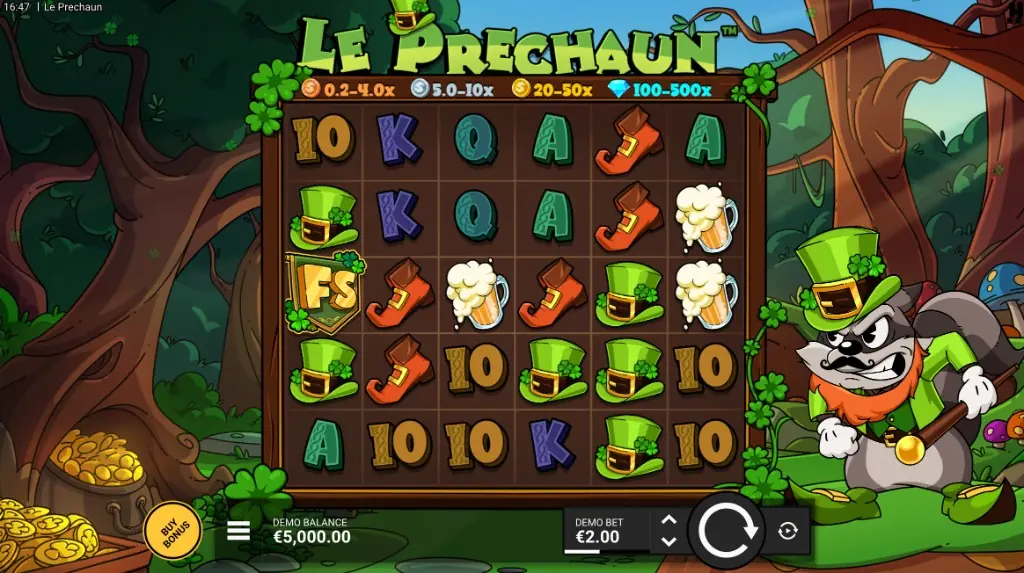
Le Prechaun uses a 6×5 Cluster Pays grid, so wins form from connected matching symbols rather than fixed paylines.
The facts before the opinion
Hacksaw Gaming lists Le Prechaun with stakes from €0.05 to €50 per spin, though the currency display and available limits can change by market. The published RTP options are 97.52%, 96.28%, 94.29%, 92.28%, and 86.31%. Hit frequency is approximately 37.8%, volatility is rated medium at 3 out of 5, and the advertised maximum win is 15,000 times the stake. The official game page is hacksawgaming.com/games/le-prechaun.
That long RTP list is the first thing a careful player should notice. A casino can offer one approved configuration rather than the top figure, and the difference is material. At 97.52%, the theoretical long-run return is €97.52 per €100 wagered. At 86.31%, it is €86.31. Neither figure predicts the result of tonight's session, but the gap changes the expected cost over a very large sample. A review that quotes only the best setting without this warning gives an incomplete picture.
RTP is calculated across huge numbers of rounds and is not a promise, cashback rate, or session target. A player can finish ahead on a lower setting and lose quickly on a higher one. Still, checking the configured percentage is a sensible decision because it is one of the few mathematical conditions visible before play. Look in the game information or help menu, not a promotional banner. If the displayed figure is unclear, the honest response is to stop rather than assume.
What the medium volatility rating feels like
Le Prechaun sits in the middle of Hacksaw Gaming's five-point volatility scale, but its presentation can feel livelier than the label. The approximate 37.8% hit frequency means some kind of win appears fairly often in the long run. Cluster size, cascades, and multiplier development determine whether that hit is tiny or useful. Several low-value connections can make the screen busy while the balance barely moves. That contrast is common in cluster games and is worth learning in the free demo.
The base game tends to alternate between short dry patches and little chains of activity. A cluster disappears, new symbols enter, and the same spin may continue through cascades. When winning symbols clear from useful positions, Golden Squares and Position Multipliers can turn a routine sequence into a stronger one. The tension comes from waiting for these systems to overlap. A single mechanic may pay little; two or three cooperating on the same cascade can change the result.
Medium volatility remains a population-level description. Ten, fifty, or even several hundred spins are too small a sample to make the stated return settle into place. The bonus modes can also concentrate a meaningful share of potential into rarer sequences. Players who read “medium” as “safe” may be surprised. There is no safe staking pattern that removes variance, and increasing the bet after losses only makes the next result more expensive.
Golden Square reveals can include coins, clovers, bags, and pots, giving ordinary cascades a chance to develop.
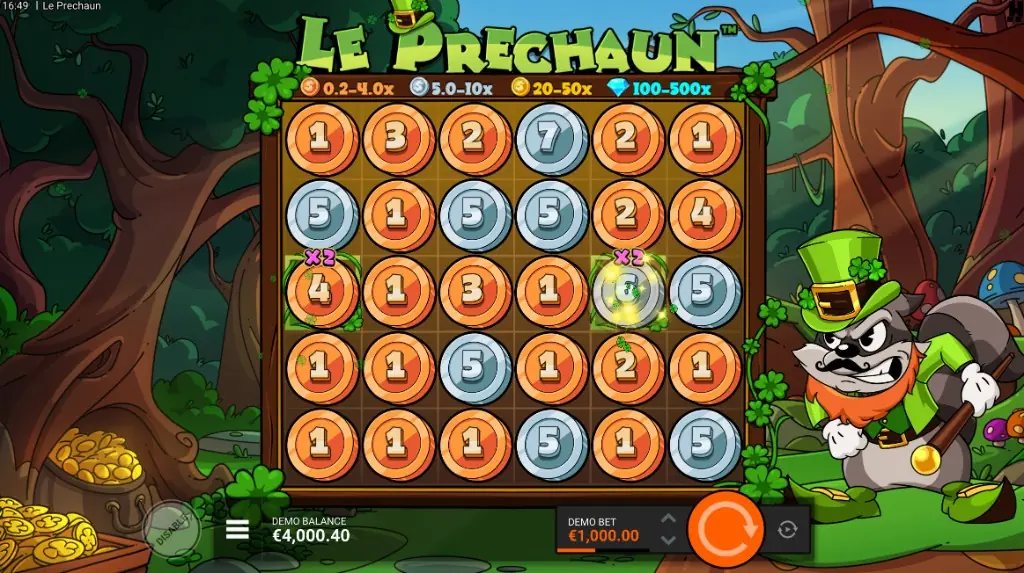
Golden Squares are the connective tissue between ordinary cluster play and the larger features. When the required action lands on or affects these marked positions, a square may reveal a coin, clover, bag, or pot. Each reveal has a different practical role in the unfolding result. Coins provide direct value, while clovers feed the Lucky Charm Bar. Bags and pots suggest stronger collections and make a developed board more interesting than a clean starting grid.
This system is satisfying because progress is visible. A Golden Square on an active part of the grid can be revisited during cascades, and a sequence with several marked spaces creates multiple points of attention. There is still no player decision inside the spin. You cannot select the next symbol, force a reveal, or preserve a promising board for later by changing stake. The game handles each outcome according to its random result.
Golden Squares also explain why Le Prechaun can feel quiet before suddenly becoming dense. An early cascade may seem insignificant until it exposes a useful item or contributes to the bar. Rainbow and Epic Rainbow events can push this collection play further. That delayed value is part of the design, though it should never be confused with guaranteed accumulation. Prior near-misses do not create a debt that the slot must repay.
The base game mixes connected symbol wins with marked positions, reveals, and progress toward stronger feature events.
Position Multipliers create the best tactical-looking moments
Position Multipliers attach extra value to locations on the grid. When activity returns to a multiplied position, the relevant values can stack and make a later cluster much stronger than the first one. This produces one of the game's clearest suspense patterns: a multiplier is ready, matching symbols gather nearby, and the next cascade either connects them or leaves the promising area unused.
Wild multipliers are especially important because wild participation can bridge symbols while adding the displayed multiplier effect. Stacking is where the upper potential begins to make sense. A single low multiplier may barely register, but combined values in active positions can amplify a solid cluster. The 15,000x cap is the published ceiling, not a normal target. Reaching it requires an exceptional outcome and should be treated as rare.
These position mechanics resemble ideas players may know from other games in the Le Bandit-style collection. The comparison is useful for describing the vibe: persistent-looking board values, chain reactions, and a comic outlaw character. It is not evidence that the probability model, feature frequency, symbol distribution, or bonus value is identical. Le Prechaun should be judged using its own help file and configured RTP.
Three free-spin features with distinct entry points
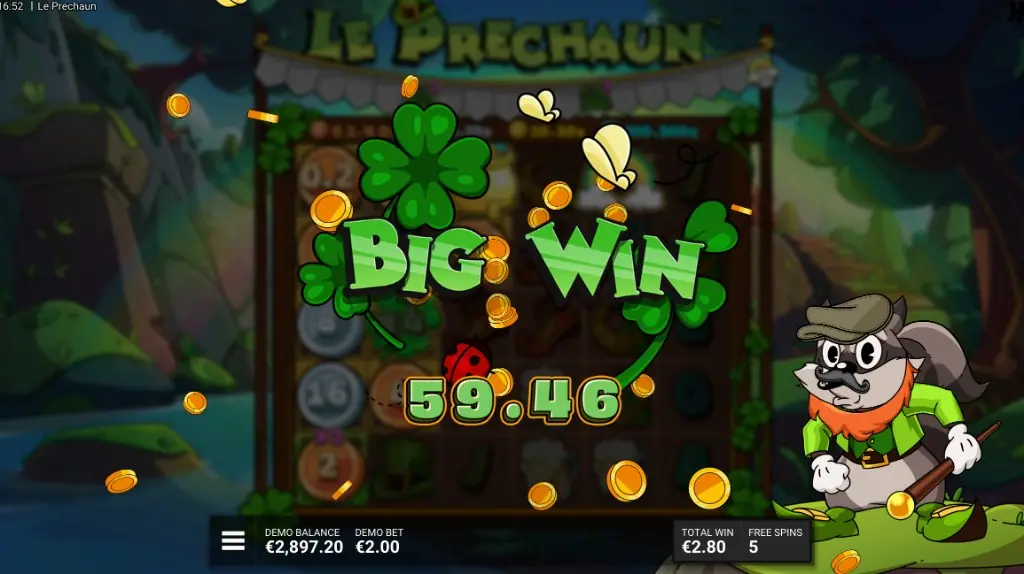
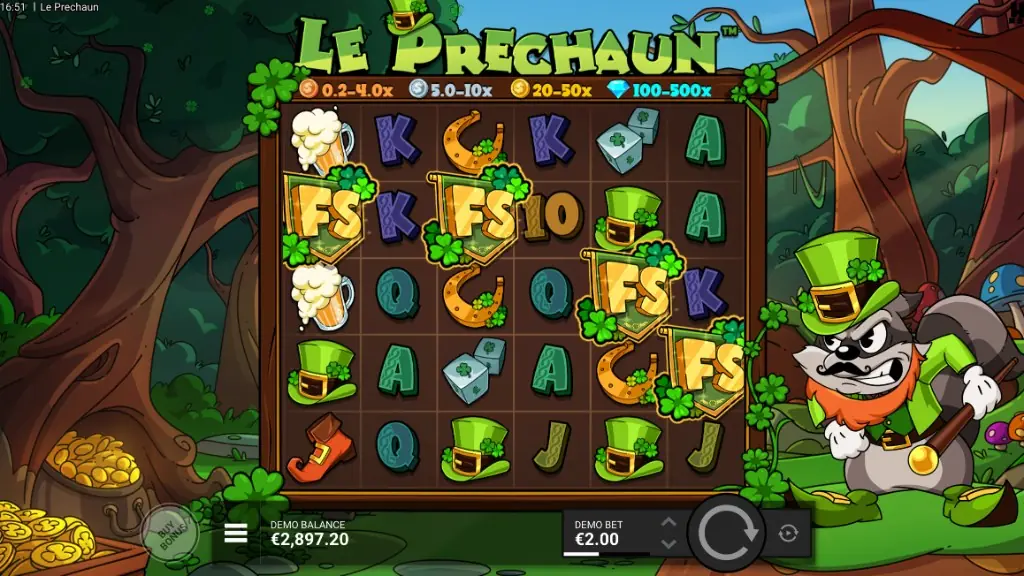
Le Prechaun offers Arc Adventure with 3 free-spin symbols, Clover the Top with 4, and Shamrock 'N' Roll with 5. The stepped trigger structure gives each extra symbol a clear meaning. Arc Adventure is the first bonus level, Clover the Top raises the feature conditions, and Shamrock 'N' Roll is the top route. The five-symbol trigger includes a Hidden Epic element, so part of its appeal comes from discovering the stronger setup rather than seeing every advantage stated on the first frame.
The names are playful, but the practical distinction is feature depth. More demanding triggers should be evaluated by what they add to the free spins, especially access to developed Golden Squares, multiplier behavior, rainbow events, or improved collection conditions. The exact rules screen inside the game is the final authority for the version being played. This review avoids inventing spin counts or enhancement values that are not among the confirmed facts.
Free spins do not guarantee profit. A bonus can trigger, animate for several minutes, and return less than its triggering stake sequence cost. Another can land the right overlaps and produce a large multiple. That spread is why the mode remains interesting, and why bankroll plans built around “getting the bonus back” are unreliable. Judge the entertainment of the chase separately from its financial outcome.
Skip Le Prechaun if visible progress meters make it hard for you to stop. The Golden Squares, charm collection, and tiered bonus symbols keep attention on the next development. They can be entertaining, but they may also encourage another spin after a planned stopping point. A firm time limit is as important as a money limit for anyone who recognizes that pattern.
It is also a poor match for players who want traditional paylines, frequent fixed-size wins, or a simple three-reel presentation. Cluster evaluation and position stacking ask for more screen reading. Anyone irritated by busy cascades or layered bonus rules will probably prefer a cleaner game. Likewise, players who need predictable session length should avoid long cascade sequences and feature buys, which are offered only where market rules allow.
Most importantly, skip any real-money version whose RTP is not clearly disclosed or whose configured percentage you consider too low. The five approved settings are far apart. No theme, bonus animation, or maximum-win figure cancels that mathematical difference. People trying to recover losses, borrowing to play, or hiding play from others should avoid the game entirely and seek appropriate support.
Final verdict
Le Prechaun is worth trying in free demo mode because its features fit together coherently. Clusters start the movement, cascades work the board, Golden Squares reveal useful items, clovers feed a visible bar, and Position Multipliers give repeat activity a reason to matter. The three free-spin entries provide clear goals without requiring the theme to carry the whole experience.
Its main weakness is commercial rather than artistic: the RTP can be configured anywhere from 97.52% down to 86.31%. That range is too large to bury in fine print. Check the number in the version in front of you. The medium 3 out of 5 volatility and roughly 37.8% hit frequency describe an active but uneven game, not a steady source of returns.